Preservation of Affordable Housing Completes Final 172-Unit Phase of Flat 9 at Whittier in Boston

Preservation of Affordable Housing, Inc. (POAH), the Boston Housing Authority (BHA) and Madison Park Development Corp. have completed The Amp, the third and final phase of Flat 9 at Whittier, a redevelopment of the former Whittier Street public housing property in Boston. The 12-story mixed-income building contains 172 apartment homes and concludes a multi-phase effort that has replaced and expanded affordable housing in the city's Lower Roxbury neighborhood.
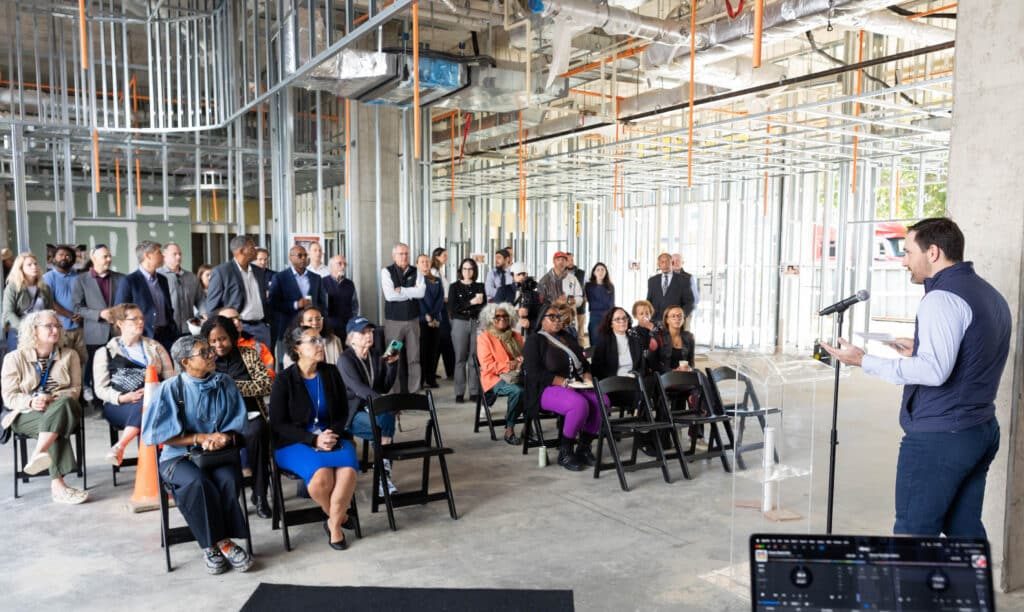
Officials recently celebrated the completion of The Amp, which offers units ranging from studios to two-bedroom apartments, along with community and commercial space. The building is located at the corner of Tremont, Ruggles and Whittier streets in Roxbury, with a project address of 100 Cabot St., Boston, MA 02120.
Flat 9 at Whittier Redevelopment: Units and Scope
The Whittier Street property was built in the 1950s and consisted of 200 public housing units. Across the three phases, the redevelopment replaced those units with 210 deeply affordable homes and created 262 additional mixed-income units across the site and the Lower Roxbury neighborhood, for a total of 472 units across the broader redevelopment and nearby Madison Park Village sites. The project's three phases delivered 316 units at the primary POAH site.
The development takes its name from the neighborhood's jazz history and provides a mix of public, affordable and market-rate housing.
The phases were delivered as follows:
- Phase one, completed in January 2020, delivered 92 family-sized apartments, a community lounge and a playground. It also created 76 additional mixed-income units at Madison Park Village, including 43 replacement units for BHA residents.
- Phase two, completed in December 2021, added 52 mixed-income units with shared community spaces.
- Phase three, The Amp, completed in September 2025, added 172 apartments in a high-rise building, along with resident amenities, roof decks, a fitness room, landscaped outdoor areas and approximately 9,000 square feet of commercial space.
Funding and Public Investment from the City of Boston
The redevelopment was initiated by a $30 million federal Choice Neighborhoods grant awarded to the Boston Housing Authority and the City of Boston in 2016. The grant supported housing redevelopment, resident services and neighborhood improvements. The City of Boston also invested $8.2 million toward the overall project.
The state's Executive Office of Housing and Livable Communities invested more than $24 million in direct subsidy, in addition to state and federal Low-Income Housing Tax Credits. Total development costs for the three phases are approximately $264 million.
Design Addresses Isolation of Former Superblock
Meena Jacob, POAH's vice president of real estate development, said the former property was an isolated superblock. "It used to be an isolated superblock of housing," Jacob said. "It's a stone's throw from downtown Boston, but residents were very isolated. The way we did our design and added two public streets, we were able to tie our work into a Boston infrastructure project. It opened up the site. It gives residents a lot more opportunity. It is allowing people who lived in the neighborhood to have affordable, high-quality housing opportunities and stay within the neighborhood."
In a video released by POAH, Jacob described the project's central goal. "The primary goal of this project was for residents to be able to stay within their community without being displaced and to live with dignity in high-quality housing that they can afford," she said.
The construction team encountered an underground stream, old steam tunnels and Boston's soft clay soil. Working with the city and neighborhood, the team overcame those obstacles.
All-Woman Development Team Led Project
The project was led by an all-woman development team. In addition to Jacob, the team included POAH vice president of construction Deanna Savage, POAH project manager Kristel Salinas and owner's project manager Alicia Toney. Collectively, they oversaw the financing, demolition and new construction of the three phases. POAH recently released a four-minute video featuring the team.
Jacob said the times have changed, with women becoming increasingly represented in development and construction. Savage, who details lessons from the project in an article, spoke in the video about community engagement. "It's not only the cost of the building, but it's how are we going to impact the neighborhood and impact that community," Savage said. "Don't just build a building. Show up to the space that we're going to be in and get the people in the neighborhood excited about what we're building, let them know that we're building it, and let them somehow be a part of that."
Market Context for Boston Affordable Housing
The completion comes as Boston faces both substantial renter demand and a difficult development environment. Boston multifamily deliveries reached more than 9,300 units in 2025, a five-year high, while high construction costs, elevated financing costs and labor uncertainty have constrained new starts in 2026.
Market indicators vary by dataset and reporting period. A July 2026 outlook reported Greater Boston multifamily vacancy at 6.4% in the first quarter of 2026, with a forecast of 6.5% by year-end, and placed the metro's size-weighted average multifamily cap rate at 5.6%. A later August report recorded vacancy at 5.6%, roughly 6,400 units of year-to-date absorption against about 3,600 deliveries, average asking rent of $3,010 per unit, annual rent growth of 2.0% and cap rates near 5.2%.
Flat 9 at Whittier combines federal Choice Neighborhoods funding, city and state subsidies, tax credits and nonprofit development capacity to produce housing for residents at a range of income levels, including replacement public housing units, within an urban neighborhood close to downtown Boston.
Sources
More Development
Hunt Midwest Breaks Ground on $90 Million Canvas Apartment Project in Downtown Overland Park
Catholic Charities Progress of Peoples Development Corporation Opens $143.4 Million Senior Housing in Brooklyn's Brownsville
Tritec Real Estate Company Breaks Ground on $175 Million Station Yards Phase 2C in Ronkonkoma